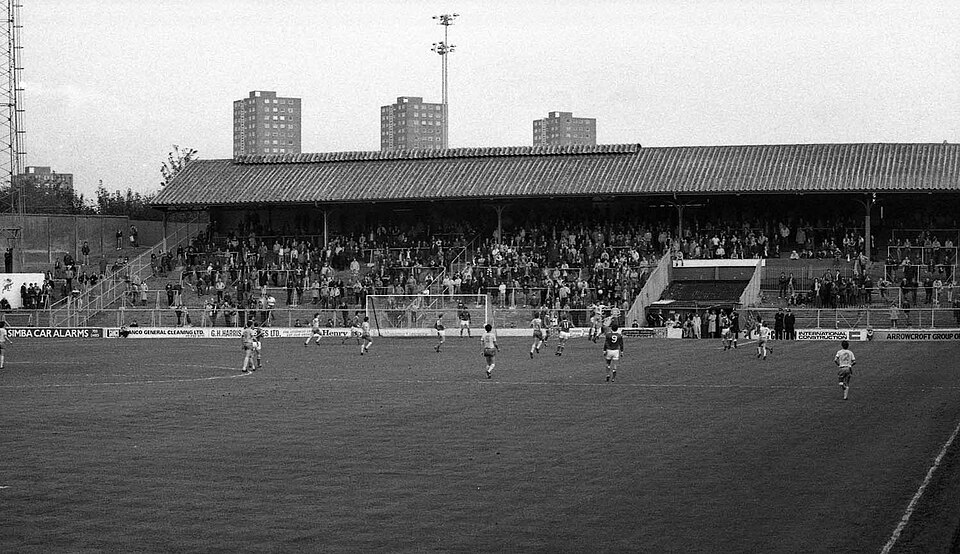
The Old Den was home to Millwall Football Club from 1910 until 1993, when the club moved to The New Den, where it remains today. An intimidating away day for any visiting supporter in its heyday, the Old Den has been the subject of many stories over the years, particularly concerning terrace culture during the 1970s and 1980s. A trip to Millwall was considered one of the most feared away days in the country.
The Old Den: The Stands and Terraces
Originally built at a cost of just £15,000, the Old Den was a four-sided stadium dominated by terracing. The Main Stand featured 4,536 seats and ran the length of the pitch. Running along the opposite touchline was the East Terrace, also known as the Railway Terrace, which was partially covered by a large roof in the centre.
The infamous Cold Blow Lane End was situated to the south of the ground and housed the most vocal section of Millwall’s fanbase. This was another entirely terraced stand, positioned behind the goal at one end of the ground.
Opposite the Cold Blow Lane End was the Ilderton Road End, a terrace that housed the club bars and supporters’ club.
The stadium’s official capacity was recorded at 22,000.
The Old Den’s Record Attendance
Before safety restrictions were imposed on stadium capacities, the Old Den had the ability to host crowds of between 47,000 and 50,000, turning out to roar on the Lions.
The club never quite reached the 50,000 mark but came fairly close with its record attendance against Derby County in 1937. A total of 48,672 supporters packed into the ground to watch Millwall secure a 2–1 FA Cup victory against the Rams.
In their final season at the Old Den, Millwall averaged 9,188 spectators in the First Division before moving a mile down the road to the New Den.
The Intimidating Atmosphere
Players and fans alike have plenty of stories from their experiences at the Old Den. Gary Lineker discussed his experience of playing at the ground on the podcast The Rest Is Football, describing the ‘wire mesh’ tunnel and the ‘fans spitting on you as you walked through’.
In 1988, Nottingham Forest manager Brian Clough once decided to stop the team bus a mile from the ground and instruct his players to ‘show no fear’ by walking the rest of the way. A similar tactic had previously been used against Clough by Leeds manager Don Revie when Clough was in charge at Derby County. The idea did not quite work, as Forest surrendered a 2–0 lead to draw 2–2.
Cardiff City supporter David Jones describes in the book Soul Crew how the wasteland surrounding the stadium was a well-known area for ambushes on away fans by Millwall’s firm, known as the ‘Bushwhackers’.
The Final Days of the Old Den
The requirements for all-seater stadiums introduced in the wake of the 1990 Taylor Report pushed Millwall towards finding a new site a mile away, on Zampa Road.
An eventful 1992–93 season marked the final campaign at the Old Den. The club had sold the stadium to Fairview Homes in 1991 but continued to play there until 1993. The Lions finished seventh, narrowly missing out on the play-offs.
Demolition of the old site began in the autumn following the end of the season.
What Happened to the Old Den?
Following its demolition, the Old Den site was redeveloped into a housing estate. Even today, Millwall fans still make their way to the New Den from New Cross Gate railway station, taking the one-mile walk through the original site. Locals refer to the area as ‘Little Millwall’.
A section of the wall that ran behind the original Main Stand remains intact between the railway tracks and Hunsdon Road. A small plaque was installed at the site by the London Borough of Lewisham. It reads: ‘On this site stood The Den, legendary home of Millwall Football Club from 1910–1993’.
Image Credit: Steve Daniels