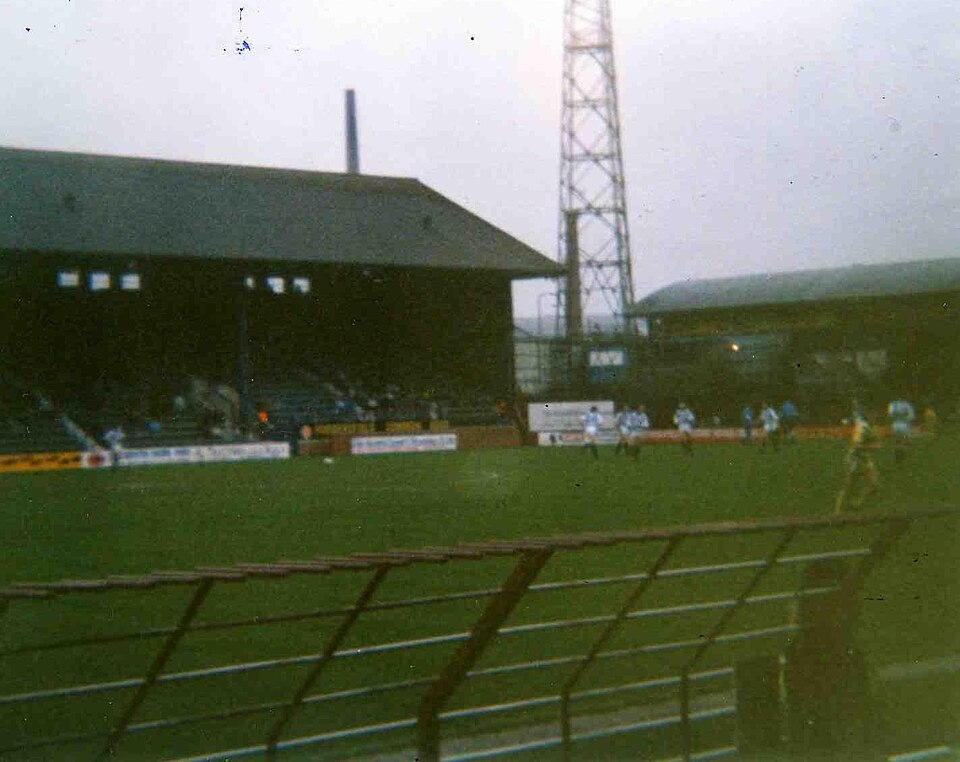
Leeds Road was home to Huddersfield Town Football Club from 1908 to 1994. The club remained at the ground until the Taylor Report, published in 1990, recommended all-seater stadiums for clubs in the top two divisions of English football. Huddersfield decided against redeveloping Leeds Road before moving to a new site, where the current Accu Stadium stands.
Leeds Road: The Stands and Terraces
Designed by Archibald Leitch, the stadium opened in 1908. The capacity of Leeds Road varied over the years, initially standing at 52,000. This was subsequently reduced to 31,000 and eventually to 16,000 to comply with health and safety regulations.
The ground consisted of a seated Main Stand, the Cowshed, the East Terrace and the Popular Terrace. The Cowshed housed Huddersfield’s more vocal supporters and was, in fact, closed for two years from 1989 after being deemed unsafe for spectators.
Interestingly, new floodlights at Leeds Road were purchased in 1961 using the proceeds from Denis Law’s transfer from Huddersfield Town to Manchester City for £55,000. They became known as the ‘Denis Law Floodlights’.
Leeds Road Record Attendance
The largest official attendance recorded at Leeds Road was 67,037 for an FA Cup sixth-round tie against Arsenal. Unfortunately, Huddersfield went on to lose the game 1–0.
Following the end of the Second World War, England played their second home international at Leeds Road, defeating the Netherlands 8–2. To date, this remains the only occasion on which the national side has played a full international at Huddersfield Town’s home ground.
Prior to their match at Leeds Road, England had played Wales at Maine Road two weeks before, securing a 3–0 victory.
The Bradford Fire Aftermath
Bradford City ended up groundsharing with Huddersfield Town at Leeds Road following the tragic fire that engulfed the Main Stand at Valley Parade during Bradford’s final match of the 1984–85 season against Lincoln City in 1985.
The fire claimed the lives of 56 spectators on the very day that Bradford City were celebrating winning the Third Division (now League One). The club used Leeds Road and Elland Road, the home of Leeds United, during the 1985–86 season while Valley Parade was being redeveloped.
Leeds Road also hosted Manchester United in 1948 while repairs were carried out at Old Trafford following bomb damage sustained during the Second World War.
The Final Days of Leeds Road
In their final season at Leeds Road, Huddersfield were targeting promotion to the Second Division (now the Championship). With that in mind, the decision was taken to move to a site less than a mile away, where the current stadium stands. The new ground was sponsored by Alfred McAlpine in its early days.
Neil Warnock was in charge during Huddersfield’s final season at Leeds Road, with Town reaching Wembley in the League Trophy, where they lost 3–1 to Swansea City on penalties. The club finished 11th in the table, winning their final game at Leeds Road 2–1 against Blackpool in front of 16,195 spectators.
Warnock guided Huddersfield to promotion the following season via the play-offs, during their first season at their new home.
What Happened to Leeds Road?
The ground was demolished and the site is now occupied by a retail park. A plaque in the car park of B&Q marks the spot where the centre spot once stood.
The inscription on the plaque reads: “This plaque marks the centre spot of Huddersfield Town AFC Leeds Road Ground 1908–1994”.
The current home of Huddersfield Town sits across the River Colne. It opened in 1994 as the Kirklees Stadium, with a capacity of 24,121.
Image Credits: Whohe! & Steve Daniels