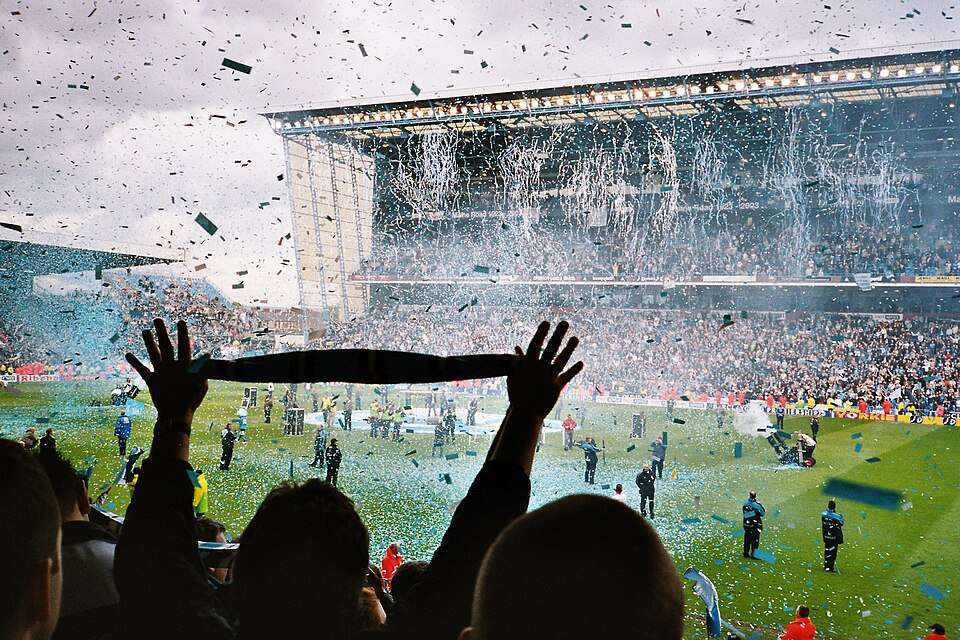
Home to Manchester City Football Club from 1923–2003, Maine Road is fondly remembered by those in City blue as a home of tough times and, in later years, jubilation, building up to the club’s move to the City of Manchester Stadium at Eastlands, now, of course, the Etihad Stadium. The club said goodbye to Maine Road after a 1–0 Premier League defeat to Southampton in the final competitive fixture held at the stadium, with tickets being sold for an eye-watering £250!
Maine Road: The Stands and Terraces
A four-sided, all-seater stadium, Maine Road consisted of the Main Stand running along the dugout side of the pitch, with a direct wrap-around link to the North Stand. The two stands together accounted for over half of the 35,150 capacity, coming in at 19,140. Away fans were typically located behind the goal in the North Stand.
The Platt Lane Stand, situated opposite the North Stand behind the goal, was a 5,000-capacity all-seater end featuring executive boxes for the home support. The original terracing in the stand was replaced by seats in 1992, along with the brand-new boxes.
Towering above Maine Road was the imposing Kippax Stand. Running the length of the pitch, the 11,010-capacity all-seater stand was the newest addition to Maine Road following its construction in 1994/95. Manchester City fan and comedian Bernard Manning famously said in his act, referencing City’s on-field struggles at the time: “City have just built a fantastic multi-million-pound new stand – the trouble is, it’s facing the pitch!”
A temporary seating arrangement was introduced in the late 1990s in the corner of the Kippax and North Stand. This was named the Gene Kelly Stand, as supporters sitting in the open temporary seating would be ‘singing in the rain’ due to Manchester’s typical climate.
Maine Road’s Record Attendance
Manchester City had the highest attendance ever recorded by an English club at Maine Road in 1934, when 84,569 supporters made it through the gates to see an FA Cup sixth-round fixture against Stoke City. Manchester City defeated a Stoke side featuring the legendary Sir Stanley Matthews 1–0.
Maine Road had reportedly been full for two hours prior to kick-off, after fans queued outside for up to five hours, with local journalists describing the supporters as being ‘packed in like sardines’. City would go on to win the cup that year, defeating Portsmouth 2–1 in the final at Wembley.
Oasis’ Legendary Gig
Two of the most well-known City fans achieved their dream of playing at the stadium in 1996 – although Noel and Liam Gallagher would be playing the guitar and tambourine respectively. Oasis would perform for two nights at the very stadium that the Gallaghers frequented as youngsters, with Noel later reminiscing about sliding under the turnstiles and learning to sing on the Kippax.
Sadly, Oasis couldn’t get near the record attendance for Maine Road, most probably because health and safety had come a long way since the 1930s. Around 40,000–45,000 fans each night danced along to hits from the albums Definitely Maybe and (What’s the Story) Morning Glory? as the band advanced to superstardom.
The band would play at the Etihad in 2005 for three nights and will return in 2027 to the home of Manchester City for their highly anticipated Live ’27 tour.
The Final Days of Maine Road
The later years at Maine Road would see Kevin Keegan take the reins from Joe Royle after Royle had led City back from Division Two (League One today) with a dramatic comeback victory over Gillingham at Wembley in the 1999 play-off final. Royle then got City a second successive promotion, this time to the Premier League, but relegation back to Division One (the Championship) would see Royle depart and Keegan arrive.
Under ‘King Kev’, the club would make an instant return to the top flight as champions in 2002. On returning to the top flight, they would then go on to beat local rivals Manchester United in a famous derby-day win, with former Red Peter Schmeichel in goal for City. Shaun Goater gave Gary Neville a nightmare afternoon as he picked the defender’s pocket to score City’s second in a 3–1 win.
Manchester City would finish ninth overall in the Premier League before saying an emotional farewell to Maine Road. In 2000, the film There’s Only One Jimmy Grimble was shot at Maine Road, starring Robert Carlyle and Ray Winstone.
What Happened to Maine Road?
After its demolition, Maine Road became a housing estate, with street names giving a nod towards its history, such as ‘Blue Moon Way’. The centre spot from the former home of Manchester City is commemorated in a special turfed area in Carnival Place.
An auction of the fixtures and fittings from the stadium raised £100,000, which was donated to local community projects in the Moss Side area surrounding the vicinity of the old ground.
Image Credit: Richard Cooke